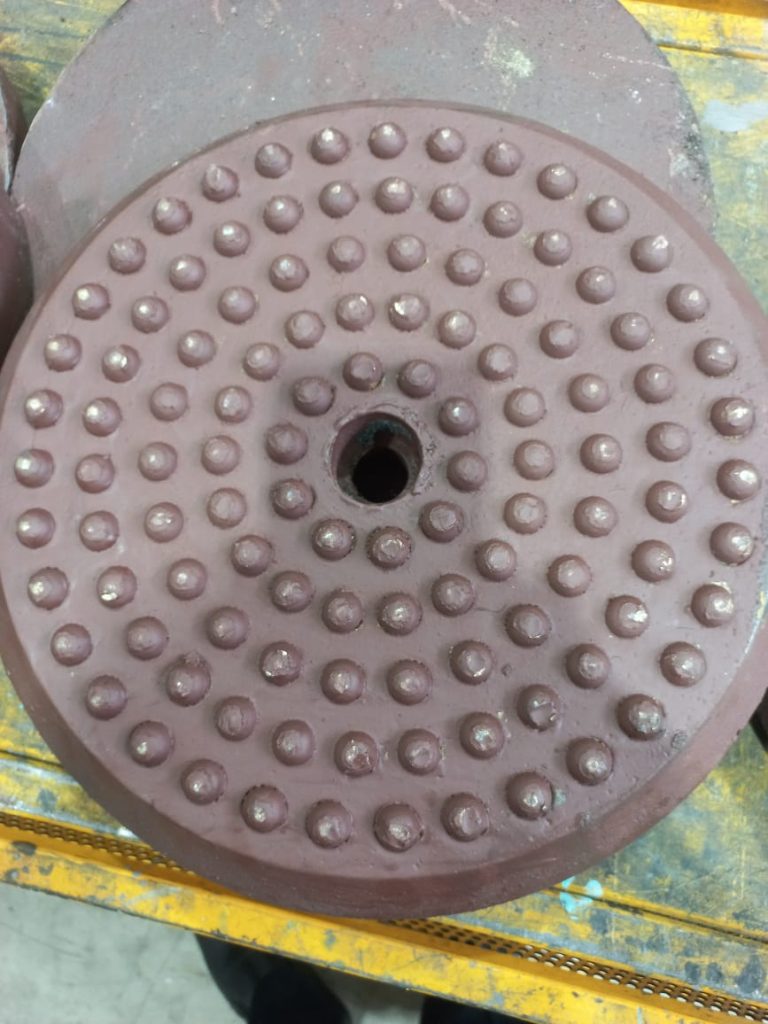
In cement and mining, wear parts performance is governed by microstructure—not just grade names. For engineers and decision-makers, understanding exact chemical composition, carbide structure, heat treatment, and hardness–toughness balance is essential to selecting the right material for each duty. At GREY Composite Wear Technologies, we engineer castings at the microstructural level to match real operating conditions.
1. Exact Chemical Composition (Range-Wise)
High chrome white irons used in wear parts are typically designed within the following windows:
18% Cr High Chrome (Impact + Abrasion Balance)
- C: 2.5 – 3.2%
- Cr: 16 – 20%
- Mo: 0.5 – 1.5%
- Ni: 0.5 – 1.5%
- Si: 0.5 – 1.2%
- Mn: 0.5 – 1.0%
Design intent: Moderate carbide volume with a tougher matrix for impact-bearing applications.
28% Cr High Chrome (High Abrasion Resistance)
- C: 2.8 – 3.5%
- Cr: 26 – 30%
- Mo: 0.5 – 2.0%
- Ni: 0.5 – 1.5%
- Si: 0.3 – 1.0%
- Mn: 0.5 – 1.0%
Design intent: High carbide density for superior abrasion resistance with reduced toughness.
Key Metallurgical Control:
- C/Cr ratio → controls carbide volume fraction
- Mo addition → improves hardenability, reduces pearlite
- Ni addition → stabilizes matrix, improves toughness
2. Carbide Structure Explanation (M₇C₃ System)
The performance of high chrome castings is dominated by primary and eutectic M₇C₃ carbides.
Types of Carbides:
1. Primary Carbides
- Form during solidification
- Large, elongated structures
- Increase hardness but act as crack initiators
2. Eutectic Carbides
- Form as a network in the matrix
- Provide bulk abrasion resistance
Engineering Insight:
- Continuous carbide networks → brittle behavior
- Refined, discontinuous carbides → better toughness + wear balance
Controlling cooling rate and chemistry helps refine carbide morphology—critical for performance.
3. Heat Treatment Cycles (Critical for Performance)
Heat treatment transforms the as-cast structure into a usable wear-resistant microstructure.
Typical Cycle:
1. Destabilization Treatment
- 950°C – 1050°C soak
- Precipitates secondary carbides
- Reduces retained austenite
2. Air/Oil Quenching
- Converts matrix to martensite
- Increases hardness
3. Tempering (200°C – 400°C)
- Relieves internal stresses
- Improves toughness
Common Failures Due to Poor Heat Treatment:
- Retained austenite → soft spots, rapid wear
- Over-hardening → brittle fracture
- Uneven hardness → inconsistent performance
4. Impact vs Abrasion Trade-Off
This is the most critical selection decision.
| Condition | Best Material Behavior |
| Pure abrasion | High carbide content (28% Cr) |
| Moderate impact + abrasion | 18% Cr |
| High impact | Manganese / tough alloy |
| Combined (real-world) | MMC |
Engineering Rule:
Increasing carbide content improves wear—but reduces toughness.
5. Recommended Composition: VRM vs Ball Mill
VRM (Vertical Roller Mill)
Wear Type:
- High pressure grinding
- Micro-abrasion + moderate impact
Recommended Material:
- 18–22% Cr with controlled carbide refinement
- MMC reinforcement for grinding zones
Reason:
VRM requires toughness + surface wear resistance due to compressive loads.
Ball Mill
Wear Type:
- High abrasion from media
- Repetitive impact
Recommended Material:
- 25–28% Cr for liners and media
- Optional MMC in high-wear zones
Reason:
Ball mills benefit from higher hardness and carbide volume for abrasion resistance.
6. Hardness vs Toughness Selection Guide
| Property | High Hardness (28% Cr) | Moderate Hardness (18% Cr) |
| HRC | 58–65 | 52–58 |
| Abrasion Resistance | Excellent | Good |
| Impact Resistance | Low | Moderate |
| Failure Mode | Brittle fracture | Wear-out |
| Best Use | Grinding media, liners | Crusher liners, hammers |
MMC: Eliminating the Trade-Off
At GREY Composite Wear Technologies, we use Metal Matrix Composite (MMC) to break the hardness–toughness compromise:
- Ceramic phase: Extremely high hardness (abrasion resistance)
- Metal matrix: Absorbs impact
- Zoned structure: Hardness only where needed
Result:
- 2–5× longer wear life
- Reduced breakage
- Stable performance across varying conditions
Conclusion
High chrome castings are not defined by chromium percentage alone—they are defined by chemistry, carbide structure, heat treatment, and application matching.
For engineers, the key is to move beyond generic grades and focus on microstructural engineering.
At GREY Composite Wear Technologies, we design wear parts based on operating conditions—leveraging advanced metallurgy and MMC technology to deliver superior performance and lifecycle value.
Because in high-wear environments, the right microstructure is the real competitive