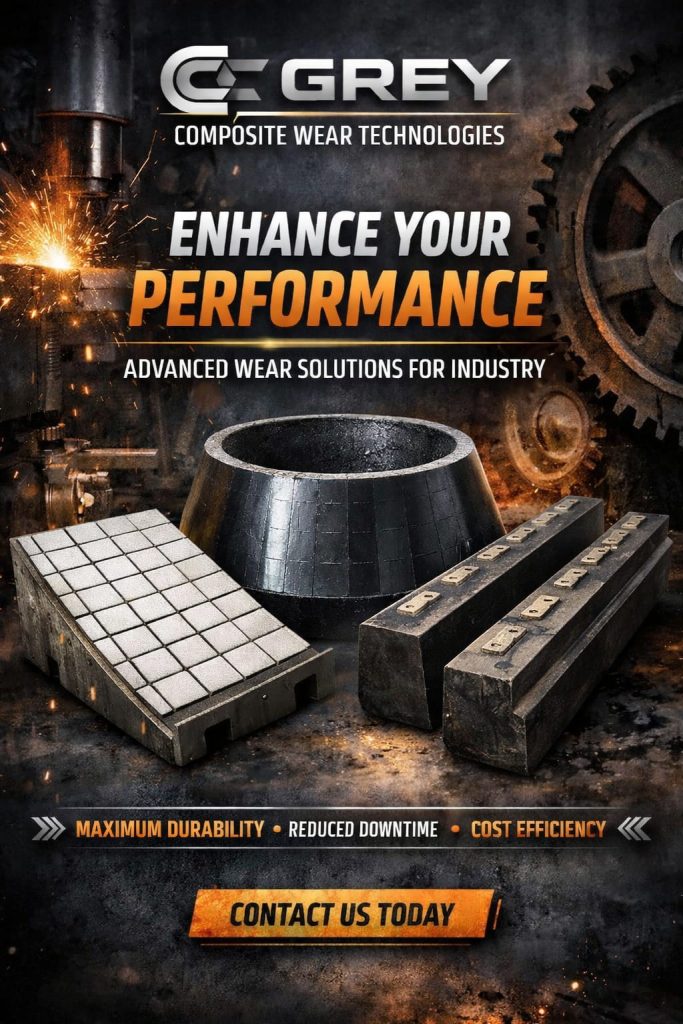
In cement and mining operations, material selection is no longer a procurement decision—it’s a performance strategy. For plant engineers and decision influencers, choosing the right alloy directly impacts throughput, maintenance intervals, and cost per ton. At GREY Composite Wear Technologies, we approach wear parts as engineered systems, not commodity castings.
18% vs 28% High Chrome Casting Difference
The fundamental difference lies in carbide volume fraction and matrix structure:
- 18% Cr High Chrome
- Lower carbide content
- Better toughness
- Suitable for moderate impact (crusher liners, clinker breakers)
- 28% Cr High Chrome
- Higher carbide density (M7C3 carbides)
- Superior abrasion resistance
- Ideal for low-impact zones (grinding media, mill liners)
Engineering Insight: Increasing chromium improves wear resistance but reduces impact tolerance. The right choice depends on wear mode, not just hardness.
Hardness of High Chrome Castings for Cement
Typical hardness ranges:
- 18% Cr: 52–58 HRC
- 28% Cr: 58–65 HRC
However, hardness alone is a misleading KPI. Two castings with identical HRC can perform very differently based on:
- Carbide morphology (coarse vs refined)
- Matrix phase (martensitic vs retained austenite)
- Heat treatment consistency
Decision takeaway: Specify microstructure and heat treatment, not just hardness.
Best Material for Crusher Liners in Cement Plants
Crusher liners operate under combined impact + abrasion, making material selection complex:
- Manganese Steel: Excellent impact resistance, poor abrasion resistance
- High Chrome: Excellent abrasion resistance, brittle under impact
- Alloy Steel: Balanced but limited in severe conditions
MMC (Metal Matrix Composite) – Engineered Solution
At GREY Composite Wear Technologies, we deploy MMC to combine:
- Tough metallic matrix → absorbs impact
- Ultra-hard ceramic phase → resists abrasion
This hybrid design outperforms conventional materials in real plant conditions.
Why High Chrome Castings Fail
Despite high hardness, failures are common due to:
1. Brittle Carbide Networks
Continuous carbides act as crack initiation paths under impact.
2. Inadequate Heat Treatment
Improper destabilization leads to retained austenite and inconsistent performance.
3. Misapplication
Using 28% Cr in high-impact zones leads to sudden fracture.
4. Residual Stresses
Poor casting design or cooling causes internal stress concentration.
Engineer’s Rule: High chrome is an abrasion solution, not an impact solution.
Abrasion Resistant Casting Material for Mining
Mining applications involve sliding abrasion, erosion, and impact. No single alloy fits all:
- High Chrome: Best for pure abrasion
- Manganese: Best for high impact
- MMC: Best for combined wear environments
MMC Performance Benefits:
- 2–5× wear life improvement
- Reduced breakage incidents
- Stable wear profile → consistent throughput
- Lower lifecycle cost despite higher initial price
What Engineers Should Prioritize
When evaluating suppliers or materials, focus on:
- Wear mechanism analysis (not just hardness specs)
- Microstructural control (carbide distribution, matrix phase)
- Application-specific design (geometry + material zoning)
- Field performance data (life, failure modes, cost/ton)
Avoid decisions based purely on price or HRC numbers.
Conclusion
When you care about material and performance, the conversation must move beyond “18% vs 28% Cr” to engineered wear solutions.
At GREY Composite Wear Technologies, we help engineers and plant heads optimize wear parts using advanced metallurgy and MMC technology—delivering higher uptime, longer life, and better ROI.
Because in modern cement and mining plants, performance is engineered—not purchased.